Last updated 2026-08-18
TL;DR
An Arkansas custom exempt slaughter license costs $100 initial and $50 a year; mobile units cost $200 initial. You need a state 'Grant of Exemption', not federal inspection. Plant buildout runs $30,000 to $150,000. Custom operators charge $100 to $150 per head, plus $0.55 to $0.85 per pound cut-and-wrap. Licensing takes 30 to 45 days.
What is custom exempt slaughter in Arkansas?
Custom exempt slaughter is when someone kills and processes livestock for the exclusive use of the animal owner's household. The meat cannot be sold. Federal law exempts this from continuous inspection under 9 CFR 303.1(a) [1], but Arkansas still regulates it. Arkansas Code § 20-57-201 pulls any custom slaughter operation under the state meat inspection law, even though the USDA considers it exempt from continuous inspection. The Arkansas Department of Agriculture's Meat and Poultry Inspection Division oversees these facilities.
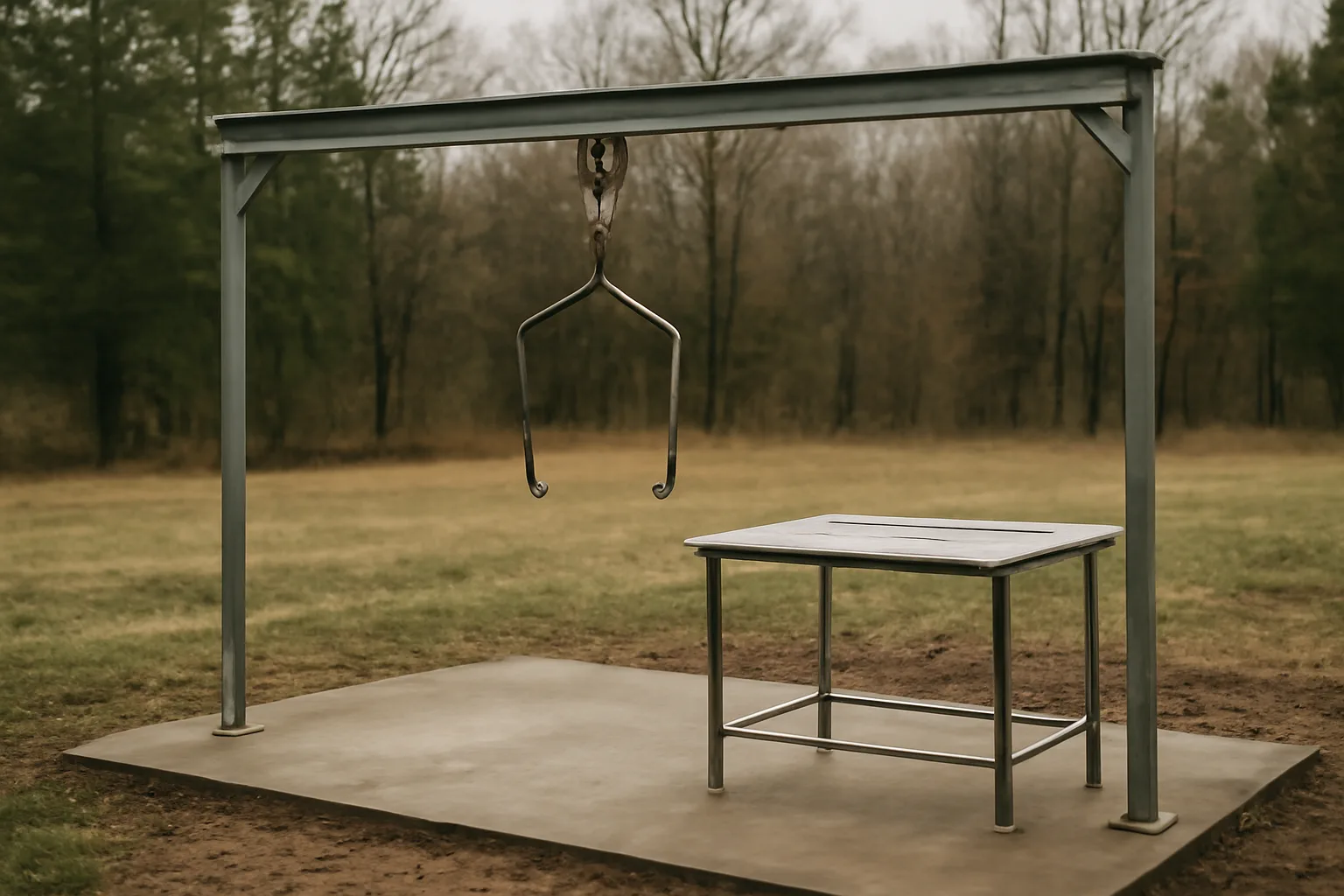
Here's what it looks like in practice. A rancher brings a steer, a family brings a hog, and the plant turns a live animal into packaged cuts for the owner to take home. Nobody in that chain can sell the meat. That restriction is what keeps the exemption alive. If you plan to sell meat, you need a different path, usually a state-inspected or USDA-inspected facility.
The custom exemption covers cattle, hogs, sheep, goats, and other amenable species. Poultry under the 1,000-bird exemption can ride alongside, but that runs on a separate federal rule.
Do you need a license for custom exempt slaughter in Arkansas?
Yes. Arkansas law is blunt about it. Section 20-57-204 of the Arkansas Code says, "No person shall operate a slaughterhouse or meat processing plant without first applying for and receiving a license from the director" [2]. Custom exempt operations get no carve-out. The state calls the license a 'Grant of Inspection Exemption' or simply a 'Custom Exempt Plant' license. Without it, your operation is illegal, even if you only do custom slaughter on your own land.
Mobile slaughter units fall under the same rule. If you run a mobile abattoir that goes farm to farm, you need a separate 'Mobile Slaughter Unit, Custom Exempt' license. Don't try to slide under the radar. The Meat and Poultry Inspection Division runs periodic sanitation checks and can shut down unlicensed plants.
You'll fill out the state's 'Application for Grant of Inspection Exemption (Custom Exempt).' The form asks for your water source, floor plan, waste handling, sanitation SOPs, and a list of species you'll handle. It isn't a federal inspection plan, but you still need the state's blessing before you touch an animal.
How much does a custom exempt slaughter license cost in Arkansas?
A stationary custom exempt plant license costs $100 for the initial application and $50 to renew each year, per the Arkansas Department of Agriculture fee schedule [3]. Go mobile and the initial fee is $200, with a $100 annual renewal. Those are the only state license fees you pay.
The fee schedule reads: "Custom Exempt Plant, Initial License Fee: $100. Renewal: $50." and "Mobile Slaughter Unit, Custom Exempt, Initial License Fee: $200. Renewal: $100."
There's no separate USDA fee, because the federal government has no continuous inspection role here. But you owe that state license fee every year, and a late renewal means a lapse you don't want.
$100 is middle of the road nationally. Some neighbor states charge nothing. Others charge double. The chart below lines up several states so you can see where Arkansas lands.
What does it cost to build a custom exempt plant in Arkansas?
The license fee is a rounding error next to the building. A bare-bones open-air concrete pad with a basic overhead rail, a kill floor, and a cooler starts around $30,000 to $50,000, according to an ATTRA feasibility guide for small-scale meat processing [4]. A fully enclosed, insulated plant with concrete walls, a cutting room, a blast freezer, and a wastewater system runs $100,000 to $150,000 [4][5]. Add value-added space like a smokehouse or aging room and some operators clear $300,000.
The big-ticket items add up fast. Graded concrete floors cost $8 to $12 per square foot. A walk-in cooler runs $8,000 to $15,000 installed. A hot water system and pressure washer for sanitation cost $3,000 to $6,000, and a kill rail with gambrel and hoist runs $2,000 to $4,000. Waste disposal is the hidden line item. You may need a grease trap, a composting system for offal, or a rendering contract, and a septic upgrade or dedicated lagoon can tack on $10,000 to $25,000.
Already own land zoned for agricultural use? You save real money. Plenty of small operators drop the plant inside an existing pole barn and stay under $40,000. The ATTRA guide notes that some farmers have built working custom exempt plants for under $30,000 using secondhand coolers and their own labor [4]. Your real number depends on scale, the species you handle, and how strictly your local city enforces building codes.
What custom processing fees should you expect?
If you're the livestock owner paying for custom slaughter, your costs sit apart from the plant's license. Custom operators charge a slaughter fee per head plus a cut-and-wrap fee per pound of hanging weight. A University of Georgia Extension bulletin reports typical beef slaughter fees of $100 to $150 per head, with cut-and-wrap fees of $0.55 to $0.85 per pound [6]. For a 700-pound hanging weight steer, that's roughly $485 to $745 all in.
Hog slaughter runs $60 to $90 per head, plus $0.50 to $0.70 per pound for processing. Lambs and goats run $40 to $75 per head. Some processors charge a flat kill fee that includes basic cutting. Others itemize every service. Mobile slaughter units often add a trip charge of $1.50 to $2.50 per loaded mile.
Building a plant to offer these services means you set your own prices. Local Arkansas classifieds in 2023 and 2024 show a $125 beef slaughter fee as common, with $0.75 per pound for standard cut-and-wrap. Call three or four operating plants in your region before you set rates. The local market tells you more than any national average.
How long does it take to get licensed and start slaughtering?
The Arkansas Department of Agriculture says to allow 30 to 45 days to process a new custom exempt license application [7]. That clock starts after you submit a complete packet with the fee. Incomplete forms, missing sanitation details, or a pending site review will stretch it.
Building the plant takes longer than the paperwork. A simple refurbished barn can be ready in 8 to 12 weeks. A ground-up building with concrete work, utilities, and equipment install typically takes 6 to 12 months. Fold in the time to source and set a walk-in cooler, get the hot water system inspected, and train staff or yourself, and a realistic window from idea to first slaughter is 9 to 18 months.
The kill itself is fast. One beef animal under a custom exempt operation takes about 2 hours from stunning to carcass halving. Chilling and cutting add another 1 to 2 weeks depending on aging. Small plants batch several animals across a day, so kill day is intense but short.
Ongoing operational costs for Arkansas custom exempt plants
Beyond the annual $50 renewal for a stationary plant, your biggest ongoing costs are water, electricity, waste disposal, sanitizers, PPE, and insurance. A small plant processing 5 to 10 beef a week might see monthly water and electric bills of $300 to $600, especially in summer when the coolers work overtime. Offal disposal varies. Composting on-site cuts hauling fees but needs land and management.
General liability insurance for a custom slaughter plant typically runs $1,500 to $3,000 a year for a basic policy [8]. You're not selling the meat, so product liability exposure is lower, but you still need coverage for injuries, property damage, and any claim of a food safety lapse. Some insurers ask for a food safety plan even when the law doesn't require one.
Budget for annual state sanitation inspections too. The inspection carries no fee, but you may need to fix noncompliance items, upgrade surfaces, or swap worn equipment. Over time, a well-run custom plant operates on $20,000 to $40,000 a year in all-in overhead, not counting your own labor draw.
Steps to apply for a custom exempt license in Arkansas
1. Confirm your site is zoned for commercial agricultural processing. Arkansas counties vary, and some require conditional use permits. 2. Download the 'Application for Grant of Inspection Exemption (Custom Exempt)' from the Arkansas Department of Agriculture website [7]. 3. Fill out the full facility description: water sources, floor plan, waste handling, sanitation procedures, and species to be slaughtered. 4. Attach a fee check for $100 (or $200 for a mobile unit), payable to the Arkansas Department of Agriculture. 5. Mail or deliver to: Meat and Poultry Inspection Division, 1 Natural Resources Drive, Little Rock, AR 72205. 6. Wait 30 to 45 days for review. An inspector may contact you for a pre-licensing site visit. 7. Receive your numbered Grant of Exemption. Post it at your plant.
CustomExemptPath sells a one-time $249 kit with every Arkansas form pre-filled and a plain checklist. It's not legal advice and it won't guarantee approval, but it saves you hours of squinting at which boxes to tick. The kit matches the exact state packet, not generic templates.
Insurance and liability costs
Custom exempt operators sometimes skip insurance. That's a mistake. A customer slips on the kill floor, or a dropped carcass leads to a claim, and now you're facing a lawsuit. A general liability policy for a small custom plant costs $1,500 to $3,000 a year, depending on coverage limits and deductibles [8]. Some insurers bundle a farm liability policy with a meat processing endorsement, which can hold costs at the low end.
You never sell meat, so you don't need product recall insurance. But ask about professional liability coverage for the processing service itself. Offer mobile slaughter and auto liability plus equipment breakdown coverage add cost. Talk to an agricultural insurance agent who knows meat processing in Arkansas. A policy for a 1,500-square-foot on-farm plant rarely cracks $2,000 a year if you have no claims history.
Custom exempt vs. state-inspected: which costs more in Arkansas?
Want to sell the meat you process? Then the custom exemption is off the table, and you need a state-inspected permit or a USDA-inspected one. The cost jump is steep. A state-inspected slaughter plant license in Arkansas runs $400 initial plus $200 annual renewal [3]. You'll also need a HACCP plan, daily inspection presence in many cases, and tighter facility standards. Buildout for a state-inspected plant typically starts at $100,000 because of the extra floor space for inedible separation, separate coolers, and the inspector's office.
Custom exempt is the cheapest legal way into slaughter processing if you stick to owner-animal work only. It's what most small on-farm plants pick. The license is $100 a year. The facility can be simpler. No HACCP plan is required, though a sanitation SOP is. The trade-off is zero meat sales. The owner must pick up the meat, and you can charge only for processing services, never a markup on the meat itself.
How to keep costs down when starting in Arkansas
Do the physical work yourself. A farmer who already has a barn with concrete, a well, and a septic system can build on that infrastructure and cut costs hard. Use a secondhand walk-in cooler. Auctions and restaurant closures often turn up working units under $5,000. Buy a used kill rail and hoist from a retiring operator. For wastewater, a simple constructed wetland or approved composting system can dodge a costly municipal sewer tap.
Skip the expensive stainless steel walls on the kill floor for now. Use FRP (fiberglass reinforced panel) over plywood. It's legal, and it cleans well. The Arkansas inspector wants smooth, non-absorbent surfaces, not beauty. On-farm processors in Arkansas have built working plants for under $35,000 by prioritizing the kill floor, cooler, and hot water first, then adding cutting rooms later [4].
More state cost guides
State rules differ, and the license fee is only one variable. We've broken down the numbers for several other states so you can compare or plan if you're near a border:
- custom exempt slaughter cost in alabama
- custom exempt slaughter cost in california
- custom exempt slaughter cost in colorado
- custom exempt slaughter cost in florida
- custom exempt slaughter cost in georgia
- custom exempt slaughter cost in illinois
Each guide covers the state-specific license, fees, buildout ranges, and timing. If you're on the Arkansas-Missouri line, read both. Missouri's license cost is zero, but the process looks similar.
Frequently asked questions
Do you need a license for custom exempt slaughter in Arkansas?
Yes. Arkansas Code § 20-57-204 requires a state-issued 'Grant of Inspection Exemption' (commonly called a custom exempt license) before you slaughter any animal for another person's household use. The Arkansas Department of Agriculture Meat and Poultry Inspection Division enforces this, and there's no carve-out for owner-only slaughter done in a facility.
How much does a custom exempt slaughter license cost in Arkansas?
The initial fee is $100 for a stationary custom exempt plant and $200 for a mobile slaughter unit. Annual renewal is $50 for stationary and $100 for mobile, per the Arkansas Department of Agriculture fee schedule. Those are the only state license fees you pay.
How long does it take to get a custom exempt license in Arkansas?
Processing a complete application takes 30 to 45 days, according to the Arkansas Department of Agriculture. Building the facility itself can take several months, so plan on 9 to 18 months total from first idea to first slaughter.
Can I sell meat from a custom exempt plant?
No. The whole point of the exemption is that the meat is for the exclusive use of the animal's owner. Selling any part of it, even to friends, voids the exemption and breaks state law. The animal owner cannot sell it either.
Do I need a HACCP plan for a custom exempt plant in Arkansas?
No. Custom exempt plants don't need a HACCP plan. You still follow basic sanitation rules and keep a written sanitation SOP that the state inspector reviews during the license application. You can write a HACCP plan voluntarily, but it adds cost and complexity you don't need.
What animals can I slaughter under a custom exempt license?
Cattle, hogs, sheep, goats, and game animals, as long as they're for the owner's own use. Poultry under 1,000 birds a year falls under a separate federal exemption. The application asks you to list the species you intend to handle. Stick to what you listed; adding species later may require a license amendment.
Is a mobile slaughter unit allowed under the custom exemption in Arkansas?
Yes. You need a Mobile Slaughter Unit, Custom Exempt license at $200 initial and $100 annual renewal. The unit must meet the same sanitation standards as a stationary plant and pass inspection. You often travel to the animal's home farm, which cuts transport stress but adds fuel and trip costs.
How much does it cost to build a small custom exempt plant in Arkansas?
A simple open-air plant runs $30,000 to $50,000. A fully enclosed facility with coolers and a cutting room runs $100,000 to $150,000. Costs hinge on whether you already have structures and utilities. An on-farm conversion using a pole barn often lands under $40,000.
Are there ongoing inspection fees for a custom exempt plant?
No. The state doesn't charge for periodic sanitation inspections. You pay the annual license renewal fee only. The inspector may visit at least once a year, but you won't get a bill for the inspection itself.
What does a custom processor charge per animal in Arkansas?
Regional beef slaughter rates run $100 to $150 per head plus $0.55 to $0.85 per pound for cut-and-wrap. For a typical 700-pound hanging weight steer, the total processing bill runs $485 to $745. Hog slaughter runs $60 to $90 plus per-pound cut fees.
Can I skip the state license if I only slaughter my own animals for my family?
It depends on where and how. The licensing requirement applies to any slaughterhouse operation, even one processing only your own animals in a slaughtering facility. If you slaughter your own animal on your farm strictly for your own household with no business involved, you may fall under a personal use exemption outside the law's scope. Offer custom services for others and you need the license.
What insurance do I need for a custom exempt slaughter plant?
General liability insurance is strongly recommended, running $1,500 to $3,000 a year. You aren't selling meat, but you carry public liability and injury risk. Some farm policies fold in processing coverage. Talk with an agricultural insurance agent specifically about custom slaughter operations.
Does the CustomExemptPath kit work for Arkansas?
Yes. The kit includes the Arkansas-specific application, sample sanitation SOPs, and a filing checklist matched to the state's current forms. It's $249 one-time and built around real state packets, not generic USDA templates.
Sources
- 9 CFR 303.1(a) (Electronic Code of Federal Regulations): Custom slaughter of livestock for the owner's household is exempt from federal inspection requirements.
- Arkansas Code § 20-57-204 (Licensing requirement): No person may operate a slaughterhouse or processing plant without a state license.
- Arkansas Department of Agriculture, Meat and Poultry Inspection Division: Custom Exempt Plant initial license fee $100, renewal $50; Mobile Slaughter Unit initial $200, renewal $100.
- ATTRA Sustainable Agriculture, 'Small-Scale Meat Processing: A Comprehensive Feasibility Guide': A basic custom exempt plant can be built for $30,000 to $50,000; fully enclosed plants cost $100,000 to $150,000.
- University of Vermont Extension, meat processing facility cost guidance: Simple enclosed slaughter plant capital costs often range $100,000 to $150,000.
- University of Georgia Extension, custom meat processing cost publication (Bulletin 1456): Typical beef slaughter fees $100 to $150; cut-and-wrap $0.55 to $0.85 per pound; hog slaughter $60 to $90.
- Arkansas Department of Agriculture, Meat and Poultry Inspection forms: Application processing for a new custom exempt license takes approximately 30 to 45 days.
- Insurance Information Institute, business liability insurance overview: General liability insurance for a small farm-based processing facility typically costs $1,500 to $3,000 per year.